


 Partners News
Schengen Evaluation - CEPOL CKC trains 29 law enforcement officials in Sofia


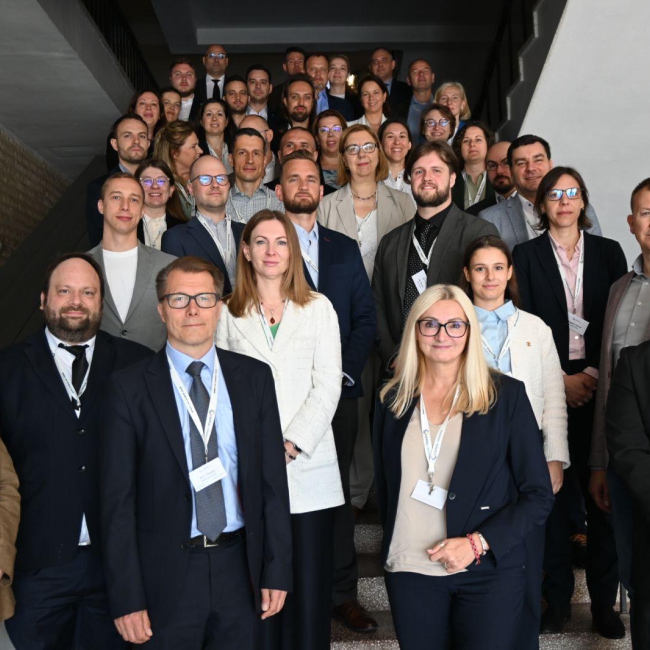
The onsite part of course 52/2025/ONS on Schengen Evaluation – Internal security: Police Cooperation and Large-Scale IT systems is taking place this week in Sofia at the Academy of the Bulgarian Ministry of Interior. This important activity from the portfolio of the CEPOL Knowledge Centre on Law Enforcement Cooperation, Information Exchange, and Interoperability (CKC INT) aims to support the implementation of the Schengen evaluation and monitoring mechanism (SEMM) established under Council Regulation (EU) 2022/922, while promoting the conduct of objective and comprehensive evaluation visits.
A priority for the European Commission, this course is also of utmost importance for our hosts this year, in preparation for the actual evaluation that Bulgaria will undergo in November. At the opening session we were honoured with the presence of Mr. Filip Popov, Deputy Minister of Interior and Senior Commissioner Prof. PhD Ivan Vidolov, Rector of the Academy of the Ministry of Interior.
Experts from the European Commission, eu-LISA, Europol, FRA, Malta, Lithuania, Belgium, and Bulgaria, who joined both steps of the course (online and onsite) are helping participants prepare themselves for the demanding role of evaluator. Twenty-nine law enforcement officials from sixteen EU Member States, 2 Associated Countries, sister agencies (Europol and eu-LISA) and the European Commission are enhancing their knowledge this week on how to deliver Schengen evaluation visits in the fields of police cooperation and large-scale IT systems (SIS/SIRENE).
The uniqueness of this complex training activity lies in the combination of three training formats: starting with the online phase, followed by self-learning, and concluding with the final phase carried out in an in person, onsite format. The programme guides participants, divided into two groups, through a big variety of topics, such as: Schengen governance, legal bases and instruments of information exchange, operational cross-border cooperation and Schengen Information System (SIS), role of Europol and eu-LISA in the Schengen evaluation process, fundamental rights and data protection issues with a focus on police cooperation and large-scale IT systems, etc. Mock-up exercises on drafting and presenting reports from Schengen Evaluation will help participants fine-tune their skills and gain a thorough understanding of the process. Through practical exercises planned during field visits, participants will help prepare their Bulgarian colleagues for the upcoming evaluation in November.
At the end of the training, participants will take a final exam. After successfully completing their final exam, they will be certified and appointed to the pool of experts and will receive the Schengen Evaluator’s Certificate from the European Commission.
CEPOL wishes all participants every success in obtaining the certificate issued by the European Commission confirming their qualifications as Schengen evaluators. We would also like to express our gratitude to our hosts and experts for supporting us in the organisation of this flagship training activity.
Related Tags
52/2025/ONS on Schengen Evaluation – Internal security: Police Cooperation and Large-Scale IT systems is part of CEPOL’s broader efforts to further professionalise and promote the mutual recognition of law enforcement training at EU level through micro-credentials. It is one of the two training activities delivered by the CEPOL’s Knowledge Centres (CKCs), whose learning outcomes were recently accepted in the curricula of the selected study programmes offered by WSB Merito University in Opole, and accredited in line with the European Credit Transfer and Accumulation System (ECTS). Participants who successfully complete course 52/2025/ONS on Schengen Evaluation – Internal security: Police Cooperation and Large-Scale IT systems, will receive one ECTS credit, within the framework of the bachelor’s degree programme in the field of Administration and Internal Security offered by the WSB Merito University in Opole.


