


 Partners News
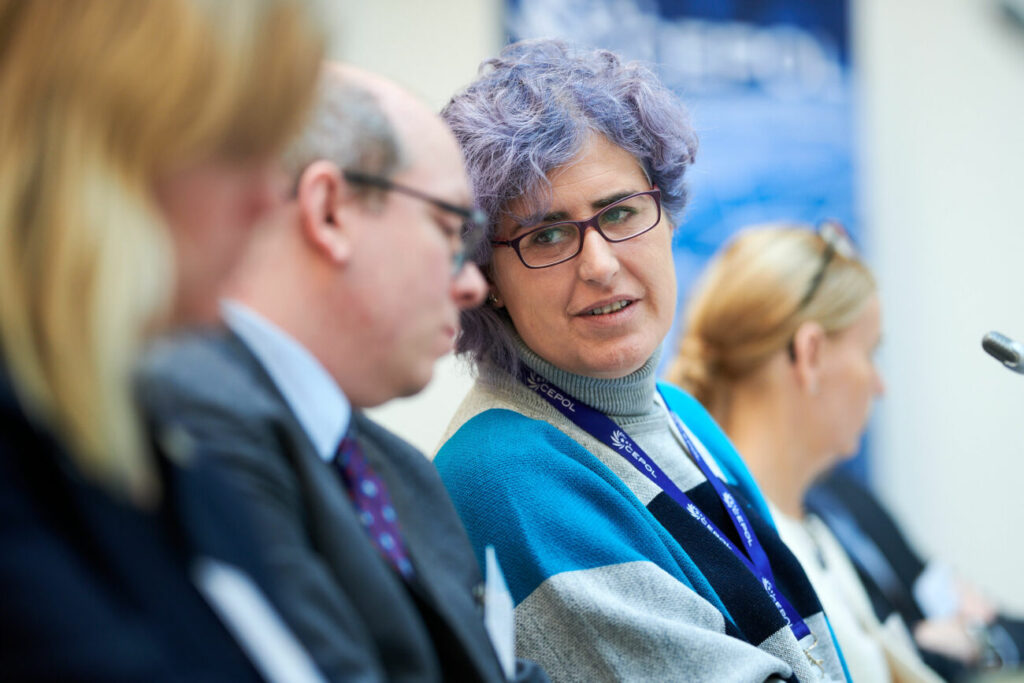
Interview with María Montserrat Marín López, the Executive Director of CEPOL


We would like to congratulate you on your position and all your efforts in successfully managing and promoting CEPOL. You have a broad experience in police training and education. Taking into consideration your former positions, do you consider CEPOL to be a challenge?
Leading the EU Agency for Law Enforcement Training (CEPOL) is an ambitious endeavour and, indeed, one of the greatest challenges I have ever faced. We are a multicultural agency, made up of individuals with very different professional profiles and backgrounds, not just police officers. This means I must be very flexible. I have the responsibility of championing multiculturalism and diversity across the board. Part of this challenge also includes steering the agency towards its new strategic objectives, such as acquiring greater relevance at European level and making it an attractive workplace, by empowering the staff, promoting their professional development and creating a sense of belonging to this great little family that CEPOL represents.
Is it difficult to be an ED and face up the heavy lifting of the 21st century?
The rapidly increasing digitalisation of society and economy as well as the emergence of new technologies are changing the law enforcement landscape and creating new vulnerabilities which call for the strengthening of law enforcement authorities. It is imperative that we train law enforcement officials on how to reap the benefits of using digital technologies, including artificial intelligence and predictive policing methods to stay one step ahead of criminals and prevent crime before it happens. At the same time, we must ensure that the principle of proportionality is applied and respected. Today law enforcement authorities must justify very well their actions, their power and the use of force. They must apply some minimum common standards and respect and safeguard the fundamental rights of all citizens. To be able to do this, they must equip themselves with new skills.
What is your advice for women in leading positions?
The key point is to avoid falling into gender-based stereotypes and stop perpetuating certain assumptions, such as soft skills versus hard skills. Leadership is about capacity, skills and competences, regardless of gender, race or religion. The real leaders are those who are able to inspire their team members, to breed a sense of belonging in their organisations and to empower their staff to create lasting changes. Women have not been in leadership positions in great numbers, but we must now aspire to be treated as equals. Rising to this challenge, we all, men and women, must constantly equip ourselves with the necessary skills and competences to hold and maintain a position of responsibility.
Is there any motto that guided you along the years?
Perseverance and humility are two of my core values. From the lowest police rank to police chief, I climbed up the ladder through tough competitive police examinations. Being perseverant helped me overcome the obstacles and setbacks I encountered along the way. Humility is also necessary as part of my job. I always try to learn from those who know best. Sometimes, I do not have the answer. That is why it is so important to surround ourselves with colleagues and professionals who are experts in their fields and have substantial inputs to make.
Which is the most successful project you have realised so far and would like to share with us?
Definitely, CEPOL represents one of them. The idea of having been entrusted with the responsibility of creating a new strategy for the organisation was slightly intimidating, but I raised to the challenge. I have enjoyed the process of putting all what I have learnt into practice and I must say I also gained a lot from the process and the colleagues and partners contributed. As a law enforcement official, the satisfaction comes from seeing the impact of our actions on society, for instance, participating in a major hit against fraud and money laundering or drug trafficking. But I would say that the greatest fulfillment comes when those impacted by our actions are vulnerable people, such as victims of trafficking in human beings or minors at risk of social exclusion.
Bearing in mind the importance of CEPOL at EU level, being a pillar in law enforcement training, what is the new strategy?
We aspire to be the EU hub for law enforcement training to facilitate the prevention and the fight against serious and organised crime, terrorism and emerging security threats. Today security threats do not stop at the border, therefore, besides providing training to EU law enforcement officials we must keep on building bridges and long-term relations with neighbouring countries while strengthening as well the capacity of their law enforcement agencies. We plan to develop new, innovative and appealing learning solutions for law enforcement officials. Our goals include fostering a common EU law enforcement culture through training and promoting accreditation of the learning activities we will be offering. In essence, we want to bring CEPOL to the frontline and enhance its role as a true meeting point for law enforcement officials willing to equip themselves with the skills they need to prevent and fight the crimes of today and tomorrow.
How are the realities that EU law enforcement authorities deal with reflected in CEPOL activities?
At CEPOL, we conduct strategic training needs assessments to identify EU-level training priorities in the area of internal security. Our EU Strategic Training Needs Assessment (EU-STNA) is developed to identify gaps in knowledge, skills and competencies among law enforcement officials. The analysis and recommendations outlined in that report are the result of a participative process, including extensive consultations with policy makers and experts across the EU. To conduct this major multiannual diagnostic exercise, CEPOL polls a vast number of organisations, including our Romanian partners, and undertakes extensive desk research of strategic documents, i.e. the serious and organised crime threat assessment (SOCTA). At CEPOL, we design our training portfolio by building on the outcomes of our training needs assessment and our training needs operational analyses, and in line with the priorities for the next 4-year cycle set by the European Multidisciplinary Platform Against Criminal Threats (EMPACT).
Has the law enforcement activity generated new methods and principles promoted by CEPOL in police chiefs’ training?
For many years CEPOL has been delivering courses to enhance leadership performance and cooperation of police leaders at EU level by strengthening the competencies of future law enforcement decision-makers, in terms of strategy formulation and implementation and change management. These courses have been incorporating real-life components into the instruction process, such as innovation mechanisms, digital leadership frameworks, the use of European instruments in the law enforcement activity, the international dimension of enforcement in line with fundamental rights and EU values, or the cooperation with research institutions and the private sector, to name a few. This year we are offering a different training activity for law enforcement leaders and police chiefs aiming at building from the ground the networks with crucial partners in view to facilitate police cooperation within the European Union and to ensure we respond collectively to the common internal security challenges. At the same time, we have put in place mentoring programmes and strengthened our higher education strategy to meet the training needs not just of senior leaders but those, as well, of middle managers.
What are, in your opinion, the personal and professional qualities that a police officer should possess?
Behaving ethically and doing the right thing, even behind closed doors. If integrity is an important quality for any professional, this is a fundamental attribute for those we work in the law enforcement field. In addition to these qualities, team work is essential to foster the spirit of co-operation and comradeship among police. Doing our job with the assurance that, no matter what, a colleague will come to help is priceless. And finally, learning as a skill, the ability and willingness to learn. Learning makes us adapt, improve and achieve the best of ourselves.
What is the most efficient way of rewarding the ambitious police officers for their activity?
In the police we do not operate like in companies, offering bonuses or a salary rise. Monetary rewards are extrinsic motivators, as they involve external gains. When a police unit gets better cars, firearms or working tools, officers might be more satisfied, but they are not necessarily more motivated. The sense of achievement, the responsibility, the self-worth from our job, those are intrinsic motivating factors. When intrinsically motivated, officers are moved to act for the responsibility or the challenge entailed rather than due to external pressures or rewards. We also know that social support in the form of recognition and praise also helps increase morale in law enforcement officers. In my particular case, the best reward is knowing that the world is a better place because of our actions.
Tell us something regarding one relevant future project of CEPOL.
Our current strategy is the most relevant future project, which is already happening in the present. We want CEPOL to be the EU hub for law enforcement training. We want to innovate, to deliver hands-on training activities, to offer new, innovative ways of learning, and provide law enforcement with real advancement opportunities, from the ground up. We plan to offer relevant accredited training activities and set up a competence framework for police officers involved in cross-border operations.
Do you consider that Romanian training institutions are efficient regarding the law enforcement educational process?
At CEPOL we do not have any specific data or balance scorecard system, therefore I am not in a position to assess or comment on the Romanian training institutions efficiency regarding the law enforcement educational process. All the information I have is from my own experience in police operations and joint investigations with Romanian partners. From an operational perspective, our Romanian colleagues have a very challenging role to play; their contribution to the fight against serious and organised crime and corruption is key. What I admire the most about them is their humility and hard-working spirit.
What is the most pleasant memory you have about our country?
My first time in Romania was in 1987, when I was very young. As part of the Spanish national handball team, we had a few competitions in Bucharest. Since then, I have been to Romania a few more times and I have witnessed the evolution and incredible progress of this country. There is only one thing that remains unchanged: your warm hospitality. I feel very close to Romania and its people!
Do you have any advice for Romanian law enforcement authorities?
To keep up the good work. Romanian law enforcement authorities are a reference for other law enforcement authorities in Europe. We are all learning from their good practices and insights on key elements of the fight against serious and organised crime, with key priorities for action within EMPACT. On a personal note, I strongly appreciate the support I have received as Executive Director of CEPOL from our Romanian colleagues.
Author: Irina Slabu – Head of Selection for International Missions, Schengen and CEPOL Unit
The original version of this interview was published on 9 June 2023 on Pentru Patrie, the central publication of the Ministry of Internal Affairs of Romania.
Related Tags


